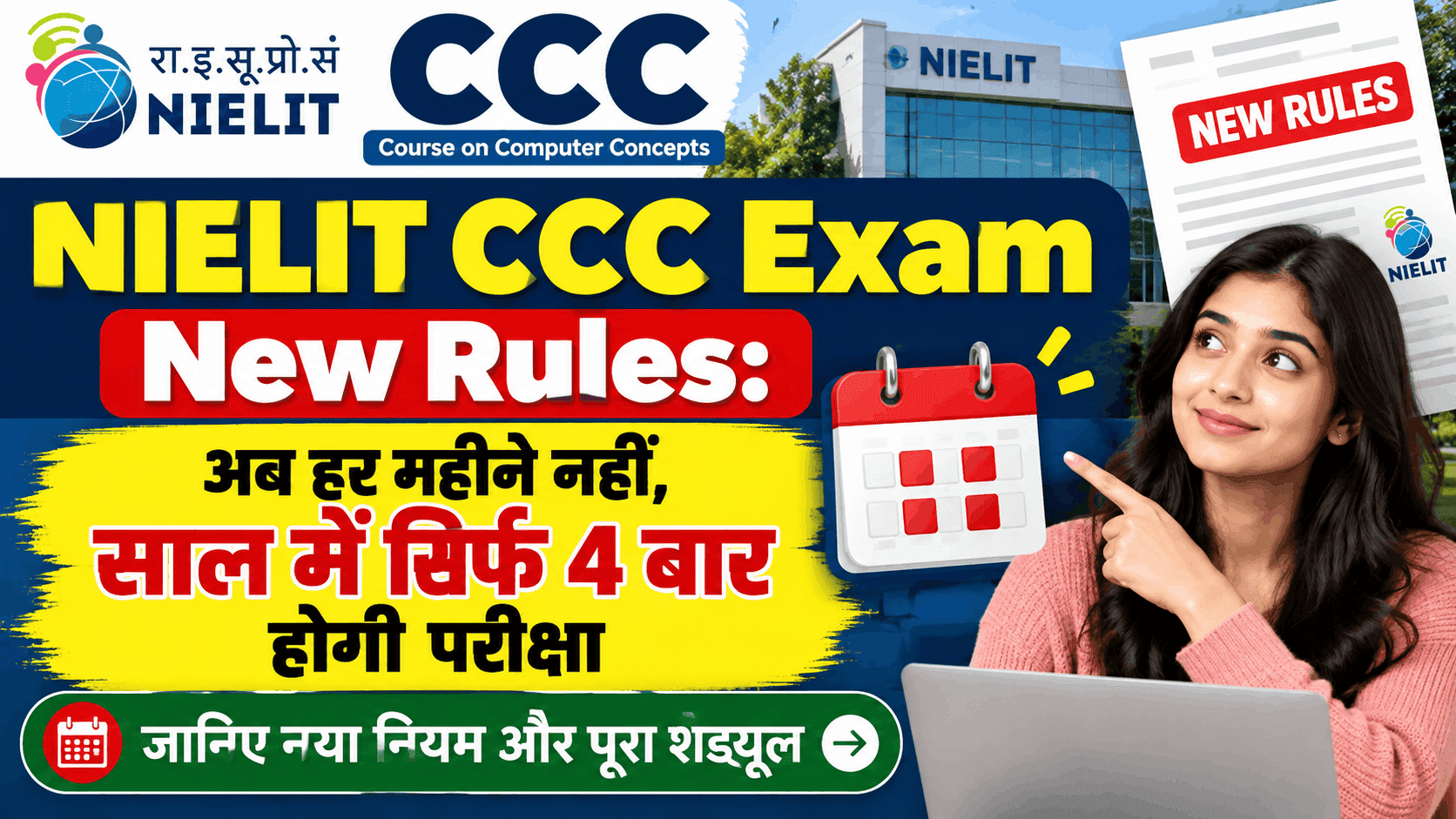
NIELIT CCC Exam New Rules: Big Changes in Exam Dates & Updated 10-Chapter Syllabus
NIELIT CCC Exam New Rules: Big Changes in Exam Dates & Updated 10-Chapter Syllabus
If you are preparing for government jobs or want a certified computer literacy credential, you must have heard of CCC (Course on Computer Concepts). Conducted by the National Institute of Electronics & Information Technology (NIELIT), it is one of the most popular computer certificate courses in India.
Recently, NIELIT introduced a monumental shift in its examination system. Under this new regulation, the long-standing 'Monthly Exam Cycle' has been completely scrapped. In its place, a Quarterly Exam System has been officially implemented.
Why was this change made? When will the exams be held now? What are the new application deadlines? How will this impact students? Let’s dive deep into the details in this comprehensive article.
1. What is the NIELIT CCC New Rule (Quarterly System)?
Previously, NIELIT conducted the CCC exam almost every month of the year. Students used to appear for the exam in the second consecutive month after submitting their forms.
According to the new rule:
The CCC exam will no longer be held every month. NIELIT has shifted it to a Quarterly cycle (once every three months). This means the CCC exam will now be conducted only 4 times a year.
The four designated exam months under this new system are:
- March
- June
- September
- December
2. New Exam Schedule and Important Deadlines (Timeline)
Due to the quarterly cycle, candidates must follow a fixed timeline to submit their forms and plan their preparation:
A) December Session
- Last Date for Online Application: Up to 31st October.
- Admit Card Release Date: First week of December.
- Exam Commencement Date: Starting from 5th December.
B) March Session
- Last Date for Online Application: Up to 31st January.
- Admit Card Release Date: First week of March.
- Exam Commencement Date: Starting from 5th March.
C) June Session
- Last Date for Online Application: Up to 30th April.
- Admit Card Release Date: First week of June.
- Exam Commencement Date: Starting from 5th June.
D) September Session
- Last Date for Online Application: Up to 31st July.
- Admit Card Release Date: First week of September.
- Exam Commencement Date: Starting from 5th September.
3. Why Did NIELIT Change the Rules?
The primary reasons behind this move are administrative and logistical:
- Better Logistics and Management: Setting up exam centers, generating unique question papers, and allocating roll numbers for lakhs of students every month was an administrative burden. The quarterly cycle gives NIELIT ample time to manage logistics efficiently.
- Faster and Accurate Results: Conducting exams four times a year ensures smoother evaluation and timely declaration of results.
- Enhanced Security and Transparency: Minimizing exam frequency allows tighter monitoring, reducing technical glitches.
4. Impact on Students (Pros & Cons)
Advantages (Pros):
- More Time for Preparation: Students now get 2 to 3 solid months to study and take mock tests.
- A Fixed, Predictable Schedule: Candidates can plan their calendar and sync CCC with other competitive exams.
Disadvantages (Cons):
- No Quick Certification: Missing an application deadline means a mandatory 3-month wait for the next cycle.
- Crowded Exam Centers: Individual exam centers might experience heavier rushes during sessions.
5. Exam Pattern and the New 10-Chapter Syllabus
- Mode of Exam: Online Computer-Based Test (CBT).
- Total Questions: 100 questions (MCQs and True/False).
- Duration: 90 minutes.
- Negative Marking: None. Attempt all 100 questions!
- Passing Marks: 50% (50 marks).
Comprehensive List of the 10 Chapters:
- Chapter 1: Introduction to Computer
- Chapter 2: Introduction to Operating System
- Chapter 3: Word Processing (LibreOffice Writer)
- Chapter 4: Spreadsheet (LibreOffice Calc)
- Chapter 5: Presentation (LibreOffice Impress)
- Chapter 6: Introduction to Internet and WWW
- Chapter 7: E-mail, Social Networking and e-Governance Services
- Chapter 8: Digital Financial Tools and Applications
- Chapter 9: Overview of FutureSkills and Cyber Security
- Chapter 10: Soft Skills and Communication Basics